
During Kent Walker’s nearly two-decade tenure as Google’s top lawyer, the company transformed from an innovative search startup into a vast empire, consolidating power across wide-ranging markets through serial acquisitions and other anticompetitive tactics. Mr. Walker seems to have viewed his role as ensuring that the law did not interfere with this empire-building. His methods included a policy of systematic evidence destruction that one federal judge described as “a frontal assault on the fair administration of justice.”
But today, the walls are closing in on Google. Despite Mr. Walker’s best efforts to conceal the company’s illegal behavior, over the past year, multiple courts have ruled that Google acted illegally to maintain its monopoly power. A jury in California unanimously ruled that Google illegally monopolized app store distribution markets, a federal judge in D.C. ruled that “Google is a monopolist, and it has acted as one to maintain its [search] monopoly,” and another federal judge in Virginia ruled that Google illegally maintained a monopolyin advertising technology markets.
As the company is held accountable for its conduct, Mr. Walker—once Google’s General Counsel and now its President of Global Affairs—continues to insert himself into debates on technology and society as a credible, civic-mindedexpert. Even as Mr. Walker may be under investigation by the State Bar of California for violating the Rules of Professional Conduct, he still markets himself to the media and policymakers as an authority on AI policy, including AI “ethics.”
After providing an overview of Mr. Walker’s discovery misconduct, this tracker chronicles examples of media outlets citing Walker’s statements (often without any context that would enable the public to evaluate his credibility) and his appearance at influential policy events.
Evidence Spoliation
Beginning in 2008, Mr. Walker, as general counsel, advised the company to engage in systematic, illegal policies to evade federal enforcers’ antitrust scrutiny. In what is known as the “Walker Memo,” he outlined a series of policies for the company to adopt to ensure that information about Google would be “less likely … [to] be discovered by an adversary and used against … [the company]”—even though the law requires defendants to preserve all relevant written evidence. Walker’s strategy included implementing an automatic deletion policy for all employee chats after 24 hours and moving sensitive discussions “off the record” to those automatically deleted chats. As the DOJ noted, the Walker memo was “an early hallmark of Google’s intent to deprive litigants of evidence.” He also developed sought to hide more evidence through false claims of attorney-client privilege.
Executives and employees from the top down at Google engaged in these illegal practices, even as the company was under DOJ investigation and legally obligated to preserve information beginning in 2019. The current CEO, Sundar Pichai—who has also been at the company for over two decades—admitted he was aware of the policies in the Walker Memo and did nothing to change them. He also admitted to copying lawyers on emails to “seek[] confidentiality for [a] document” under false pretenses to prevent business communications from being revealed to plaintiffs and courts. Mr. Pichai also testified that he relied on his legal team—particularly Mr. Walker—to instruct him properly on document retention. Even still, Mr. Pichai said in one instance, “also we can change the setting of this group to history off.”
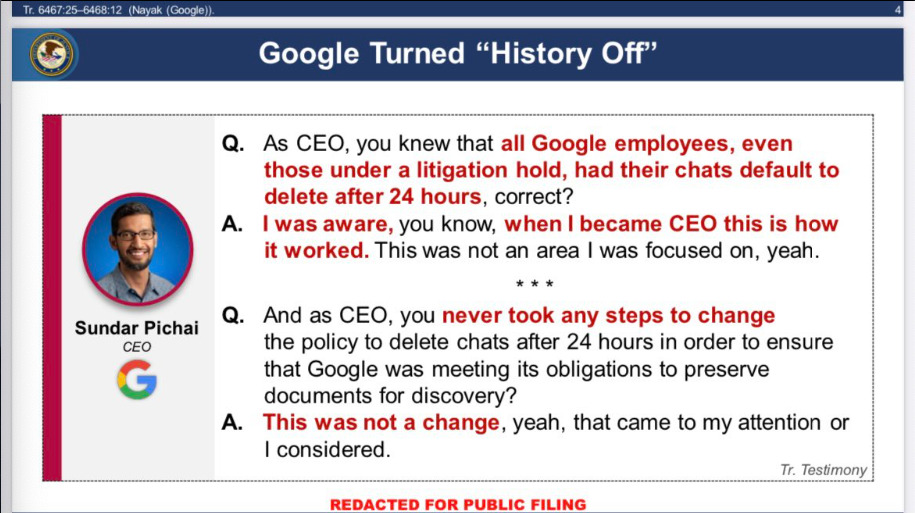
There are numerous other employees who have also spoliated evidence. As just two of many examples, one employee stated, “I really feel super uncomfortable [with] us continuing this on the record,” and another wrote, “I see that [h]istory is on in this chat. If that can’t be changed, can I please be removed…?”
In January 2025, a group of Texas state attorneys general filed a motion alleging evidence spoliation, marking at least the fourth antitrust case compromised by Walker’s policies. The motion revealed that Google failed to implement litigation holds, even years after the company was legally obligated to do so. This meant evidence beyond just chat messages, including emails, could have been deleted as well.
Shareholders sued Google for its widespread compliance misconduct, explicitly citing the spoliation of evidence among other concerns. In a settlement, the company agreed to spend $500 million over the next decade to overhaul its compliance program. The settlement’s size further illustrates the severity of Google’s and Walker’s actions and indicates the need to hold those responsible accountable.
Judges Shocked By Google’s Misconduct
Judges presiding over Google’s recent antitrust cases have called out company executives for their behavior. During the Epic v. Google trial, concerning Google’s app store monopoly, Judge James Donato noted that Kent Walker’s testimony was “evasive” and “materially inconsistent with testimony given by Google’s witnesses,” sharing that “this presents the most serious and disturbing evidence I have ever seen… with respect to a party intentionally suppressing potentially relevant evidence in litigation.” Judge Donato also accused Mr. Walker of “tap-dancing around” questions about why exactly he chose not to preserve company communications. And in the Google search case, Judge Amit Mehta stated that “the court is taken aback by the lengths to which Google goes to avoid creating a paper trail for regulators and litigants.”
Google’s tactics to delete and hide evidence under the direction of Mr. Walker have “created administrative chaos” in litigation schedules and ultimately delayed justice for Google’s illegal behavior. As a result, the DOJ requested sanctions against Google for document spoliation, including the presumption that “Google intended to maintain its monopoly.”
Judge Donato sanctioned Google by informing the jury that they could presume any deleted evidence would have been unfavorable to Google; the jury ultimately ruled against Google on all counts. Judge Mehta abstained from formally adopting that presumption because it was moot in light of his merits ruling against Google. Similarly, Judge Leonie Brinkema concluded Google’s spoliation “may well be sanctionable” in April but decided against adverse inference or sanctions because the court determined that it had sufficient ground to find that Google illegally maintained its ad tech monopoly regardless of the deleted evidence.
AI “Ethics” Lobbying
As the current President of Global Affairs and Chief Legal Officer of the company, Mr. Walker has a vested interest in a hands-off approach from regulators and the courts. He has benefited greatly from his senior role at the company. At the same time, he has evaded personal responsibility for enabling his employer to violate federal and state laws.
Below, we outline the various public statements Mr. Walker has made in an attempt to save both his and Google’s reputation, and to push the false narrative that the government is “pushing a radical … agenda” and “overreaching” when enforcing laws Google has violated, or that the government will “break products… that people love.” Contrary to Mr. Walker’s statements, over 60 percent of voters agree that big tech firms need to be broken up. And case law endorses this and other remedies to open markets to real competition and deprive Google of the fruits of its ill-gotten gains.
Further Reading
Read Economics Liberties’ Letter to the California State Bar Regarding Kent Walker’s Discovery Misconduct here.
Read Economics Liberties’ Brief “Google Broke Internet Search. It’s Time to Break Up Google,” here.
Read Economic Liberties’ Amicus Brief in Epic v. Google here.
Read Economic Liberties’ “Big Tech Abuses” Tracker here.
This data was last updated on 7/24/2026.
| Date | Title | Source | Category | Subject | Details |
|---|---|---|---|---|---|
| 05/12/2026 | Kent Walker on LinkedIn | LinkedIn Post | AI Policy | Walker posted a public reflection comparing US AI usage to China, claiming that “too much red tape gets in the way of state capacity and ‘business capacity’—the ability to deliver real value in people's lives.” He urges Americans to focus on “catch[ing] up” in the “AI race.” | |
| 2/18/2026 | Google’s Kent Walker Talks AI, Competition, Digital Regulation | Law360 | Article | EU AI Policy | During a speech in Dublin, Ireland at the Institute of International Affairs, Walker reiterated his belief in the transformative power of AI, and used that as justification for the streamlining of regulations across the EU. He argued that tech offers a “reset button” for policy in Europe. In other words, Walker hopes that the transformative era of AI will lead to less restrictive, pro-innovation EU policies which place Google at the forefront of AI development in Europe. |
| 2/17/2026 | Google Pushes AI-First Security at Munich Conference | The Tech Buzz | Article | AI Policy | Walker advocated for a “full stack, AI-driven approach” to countering cyber attacks at the 2026 Security Conference, which was held in Munich, Germany. The strategy seeks to implement AI at every digital layer of governmental and corporate organizations. Walker hopes Google will lead this charge, a move that would consolidate control of the cyber-security systems of some of the most important organizations in the world into the hands of Google. |
| 2/12/2026 | Google warns EU against ‘erecting walls’ in tech sovereignty push | The Financial Times | Article | Foreign Technology | Walker critiqued the EU for enacting new tech restrictions as a part of what it calls “tech sovereignty,” a strategy which the EU hopes will ensure European financial independence in the technology sector. Walker expressed his concerns about the restrictions impacts on Google’s future in AI development in Europe. |
| 2/6/2026 | Google Calls for Quantum Security Overhaul Amid Rising Threats | The Tech Buzz | Article | Encryption policy | Walker urged governments to implement regulations countering the harvesting of encrypted data. Walker claims that current harvesting is a precursor for future quantum-powered decryption attacks. The fear is that the encryptions that protect everything from private messages to money transfers could be rendered useless within years if quantum-resistant encryption is not implemented. |
| 12/19/2025 | Several AI Policy Issues to Watch in 2026 | Kent Walker on LinkedIn | LinkedIn Post | AI Policy | Walker posted a list of the AI policy issues that he believes are the most pressing as we enter 2026. Walker seeks to ensure rapid economic growth, limit regulations that ‘hinder innovation’, and accelerate investments, while maintaining minor safety, mitigating false content, and protecting Intellectual Property. |
11/10/2025 | The $30 Million Lawyer: GCs Take on New Duties to Up Their Pay | Bloomberg Law | Article | Compensation | Walker was the highest paid in-house lawyer in 2024 among S&P 500 firms, making $30.2 million a year. Ninety percent of Walker’s total compensation was in stock; he received $3 million in cash, including $1 million in base salary. Bloomberg Law linked Walker’s record pay to his expanded role as “President of Global Affairs,” which goes beyond a traditional general counsel position and reflects Google’s “intense regulatory and strategic demands.” |
| 10/01/2025 | Google: EU’s AI adoption lags China amid regulatory hurdles | AI News | Article | AI Policy | Walker argued that the EU was at risk of falling behind China in the AI race with immense geopolitical and national security consequences. Walker laid out a three-prong strategy “for the EU to reclaim its AI footing,” which rested on deregulating tech, building up adoption in the workforce, and scaling support for widespread AI adoption. |
| 9/19/2025 | Who’s donating millions for, against Prop. 50, California’s redistricting fight? | The Sacramento Bee | Article | Lobbying | Walker donated $15,000 to Newsom’s ballot measure campaign while the governor was considering a bundle of AI regulation bills. |
| 7/30/2025 | Google will sign up to EU’s AI Code despite concerns | Euro News | Article | AI Policy | Walker expressed concern regarding the EU’s AI code of Practice on General Purpose AI (GPAI). Walker said, “While the final version of the Code comes closer to supporting Europe’s innovation and economic goals [...] we remain concerned that the AI Act and Code risk slowing down Europe’s development and deployment of AI…In particular departures from EU copyright law, steps that slow approvals, or requirements that expose trade secrets could chill European model development and deployments, harming Europe’s competitiveness.” |
| 7/15/2025 | A summer of security: empowering cyber defenders with AI | Blog Post | AI policy | Walker highlights Google’s new AI tools to bolster cybersecurity. He notes that AI offers an “unprecedented opportunity” and can “give the advantage back to security defenders”. The blog features Google’s “Big Sleep” AI agent (from DeepMind/Project Zero), which autonomously searches for software vulnerabilities. Big Sleep recently detected a critical SQLite vulnerability known only to attackers, and helped Google preemptively patch it. | |
| 7/09/2025 | Inside the fight of Google’s life | The Wonk Podcast | Podcast | AI Policy | To meet rising energy demands, Walker stated that Google was seeking to reform permitting in the US to bring (green) sources of energy from “remote areas to where they are needed, which are highly populated areas.” Walker stated that the “next 5 years will be the most fundamental transformation of [Google].” The ultimate goal of the firm, according to Walker, is to reduce marginal costs to zero. Walker stated, “that’s when the magic happens” in explosive innovation. |
| 4/25/25 | Bloomberg Law | Article | Compensation | Kent Walker received $30.2 million in total compensation for 2024, with approximately 90% coming from stock awards. In 2021, his compensation totaled $50.9 million. He has led Google’s pushback against the DOJ’s proposed remedies, accusing the agency of pursuing a “radical interventionist agenda.” Walker remains one of Google’s highest-paid and most influential executives despite his central role in the company’s systematic destruction of evidence. | |
| 4/17/2025 | Google’s Kent Walker Calls for Unified Standards on AI | Washington AI Network | Podcast | AI policy | “Walker emphasized the need for faster federal adoption of AI tools, streamlined procurement and investments in infrastructure, from permitting reform to energy capacity, that support next-generation tech development.” “But the most striking part of the conversation may have been Walker’s assessment of global competition. 'We thought we were a couple years ahead. Now we think we’re a few months ahead,' he said, referencing China’s rapid scaling of AI resources. With over 200,000 AI startups and hundreds of millions of users engaging with large language models, China is moving fast—and so must the U.S.” |
| 4/16/25 | Google’s Kent Walker on AI Standards, Quantum Breakthroughs, DeepSeek, and the DOJ Case | Washington AI Network | Podcast | AI Policy | Walker is presented by the podcast host as the premier expert on AI policy. He largely echoes his talking points in Google’s comments on the U.S. AI Action Plan He calls for increased government investment in energy, AI adoption by federal agencies, and procurement regulations that expand public sector use. He warns against a “patchwork of regulation.” He argues that policymakers should “regulate the outputs, not the inputs” and avoid interfering with how AI systems are built. He warns that China will catch up if these proposals are not enacted. |
| 4/02/2025 | A practical approach to creative content and AI training | Blog | AI Policy | Advocates for a partnerships based approach to creative content and AI data training, quietly rebuffing any substantial regulatory changes. Essentially, says existing regulatory frameworks applied in sightly different ways and the market can resolve current AI training issues. “It’s important to acquire content responsibly and lawfully, such as by giving web sites the ability to opt out of having content or information on their sites used for AI training. Existing industry standards governing web crawling are an important way to accomplish this.” “When it comes to avoiding use of individuals' voices and likenesses, legislative frameworks can build on existing “notice-and-removal” systems for copyright, including proper safeguards to prevent abuse.” “There may be opportunities for commercial partnerships when AI services “ground” responses on facts from web sites.” | |
| 3/13/2025 | Google’s comments on the U.S. AI Action Plan | Blog | AI policy | Walker’s response to the Office of Science and Technology Policy’s RFI calls for investment in energy infrastructure, export controls protecting national security but also enabling global AI services, expanded partnerships with government labs, and streamlined AI procurement and adoption. “We also need export controls that both protect our national security and enable America to export and provide AI services in foreign markets. American scientists need access to computational resources for research, which means forging new advanced partnerships with national labs;” continues that “The government should lead by example in AI adoption and deployment” and should “champion market-driven and widely adopted technical standards by building on the Commerce Department’s leading role with the International Standards Organization and other standard-setting organizations… Finally, the Administration can support American AI leadership by combatting restrictive foreign AI barriers.”” | |
| 2/20/2025 | AI at the Forefront: Conversations with World Leaders in Munich and Berlin | LinkedIn Profile Page | Blog | AI policy | Emphasizes the need for widespread implementation in order to stay at the forefront of technological innovation. “In my conversations with various European leaders, I stressed the need for a pro-innovation agenda to realize AI’s potential to revolutionize science, defend against sophisticated cyberthreats, and deliver generational progress that benefits people and society.” “Last year, Google and Implement Consulting estimated that widespread adoption of AI tools could boost the EU’s GDP by up to €1.4 trillion…Technology races are often won not by the first to invent, but by the best to deploy. So it’s time to get serious about seizing the opportunity ahead.” |
| 2/6/2025 | AI Policy | ||||
| 1/29/2025 | Blog | AI Policy | |||
| The Next Steps for Responsible AI | The Atlantic | Public statement | AI policy | ||
| 11/25/2024 | Halifax International Security Forum 2024: When AI Meets Geopolitics | Halifax, Politico | Public statement | AI policy | need to "harmonize AI regulations and pro-innovation agendas"remove barriers to innovation. |
| 11/22/2024 | Google representative responds to Justice Department antitrust proposals | NPR-All Things Considered | Public statement | Google search remedies | that hrome would jeopardize people's privacy; says that banning Google from paying companies to make Google the default w hurt other companies; ignores role of anticompetitive tactics in claiming Google is superior in search. |
| 11/21/2024 | DOJ’s staggering proposal would hurt consumers and America’s global technological leadership | Blog | Google search remedies | Claims the DOJ is pushing a “radical interventionist agenda ” instead of proposing remedies “related to the issue in this case”; alls the remedies proposal overbroad, going beyond the court’s decision; it will “break … products … that people love and find helpful”; ays the remedy is government overreach that would hurt consumers, developers, and small businesses, and jeopardize leadership. | |
| 10/16/2024 | AI’s Promise for Security and Prosperity—And What We Need to Do to Fulfill It | The Aspen Institute | Article/Opinion piece | AI policy | Claims that smart AI regulation “balanced”; alls for “targeted rules” that “regulat[e] outputs ; ays there is an AI arms race and for national security purposes we should “get to work” |
| Mid-2024 | The Sweet Spot | The Atlantic (sponsored content from Google) | Public statement | AI policy | Says there is a risk of under and over regulation, and hopes to "share the benefits of [Google's] experience with governments" to hit a sweet spot. |
| 10/13/2025 | Kent Walker, Google’s President of Global Affairs, explores Europe’s AI-driven future at IE University with Dean Enrico Letta | IE University News | Event / Article | AI Policy / EU Digital Regulation | Walker spoke at an IE University event on “Europe’s Digital Future: Sovereignty, Safety & Global AI Competition,” arguing that fragmented EU rules and slow AI adoption threaten European competitiveness. Walker warned that while sovereignty should “protect what really matters,” he expressed concern that its overexertion could lead to “isolation.” |
| 10/08/2025 | The US can’t just invent a future with AI — it must deploy it. | The Hil | Op-Ed | AI Policy | Walker claimed that “the nations which deploy AI at scale will be the nations that come out on top,” and while America leads in AI innovation, it critically lags at deployment and adoption. Walker cites that over 600 million Chinese already work with LLMs, 83% of Chinese businesses use AI, and China has 200,000+ new AI companies. He blames American "dystopian cultural framings" from films like Terminator for creating skepticism. |
| 06/02/2026 | Trump Signs Executive Order Seeking Oversight of A.I. Models | New York Times | Article | AI Policy | Trump signed an executive order for tech companies to allow government oversight in developing AI intelligence models. Kent Walker praised the order as an “important step forward” towards AI safety and innovation. |
| 04/28/2026 | Google Defends Military Work After Employee Backlash to Pentagon Contract | The Information | Article | AI Policy | Despite protests from over 600 employees, Google signed an agreement with the US Department of Defense, allowing the Pentagon to use their AI models for classified work. Kent Walker responded to employees with an internal memo claiming: “We have proudly worked with defense departments since Google’s earliest days, and we continue to believe that it’s important to support national security in a thoughtful and responsible way.” |
| 04/09/2026 | Google hits out on California tech and antitrust measure | Politico | Article | Lobbying | Walker criticized California’s newly proposed BASED Act (SB 1074), which would prevent large tech platforms from favoring their own products over those made by smaller rival companies. Walker claimed the Act would degrade user preference and asserted: “It’s widely recognized that Europe’s regulatory attempts to spur competition in the tech sector have failed. California has no reason to repeat the mistakes of Europe’s unsuccessful DMA experiment.” The bill did not pass. |
| 3/30/2026 | Evolving expectations of what’s possible | Blog | AI Policy | Walker shares Google’s perspective on the future of privacy at IAPP’s 2026 Global Summit, emphasizing the market potential and consumer desire for personalized artificial intelligence. He describes how Google’s new Personal Intelligence feature can connect an individual’s personal information from their Gmail, Photos, and other applications to provide “tailored” experiences to each user. | |
| 6/25/2026 | Read our white paper on a pragmatic approach to AI governance in America. | News from Google | Whitepaper | AI Policy | Kent Walker and several Googlers created a whitepaper that calls for an independent, industry-funded oversight body to set safety benchmarks and conduct audits for frontier AI models. The framework advocates for enforcing sector-specific laws to address harms like copyright infringement, privacy, and child safety rather than creating new agencies. |
| 6/30/2026 | Welcome to “The Why of AI” | Article | AI Policy | Kent Walker started a new monthly series where he explains the context behind AI tool creation and highlights how they are useful for everyday activities. | |
| 7/16/2026 | The DMA should not undercut security & privacy for European | News from Google | Blog | AI Policy | Kent Walker claims the new EU rulings threaten European users' privacy and device security by forcing Android to give sensitive system permissions to unvetted third-party apps. He asserts that Google will keep pushing regulators for a balanced approach that protects user safety while meeting market rules. |
| 7/24/2026 | Trump says the US will investigate EU trade practices, claiming the bloc unfairly fined tech giants | Audacy | Article | AI Policy | Kent Walker criticizes the recent string of EU penalties against major US tech giants, claiming that they were causing “product degradation driven by a small group of self-serving complainants.” He further argued that the DMA forces Google “to strip away real-time search features Europeans love" and “dismantle safety protections on Google Play.” |