‘Judges are just blessing monopolies at this point,’ Economic Liberties Calls On Congress to Step In and Regulate Big Tech Following News That Google Beat US Bid To Force a Break Up
Washington, D.C. — Following today’s remedies ruling rejecting the Department of Justice’s (DOJ) proposed breakup of Google’s ad tech monopoly after the company was last year found guilty of illegally monopolizing key pieces of the online advertising marketplace, the American Economic Liberties Project released the following statement:
“Judges keep finding Google guilty but Google keeps walking away with both its ill-gotten gains and its empire intact,” said Laurel Kilgour, Research Manager at the American Economic Liberties Project. “Without actual structural remedies, antitrust rulings are just inconvenient speed bumps that allow Google to lock down search and ad tech markets today while using that same unchecked power to monopolize tomorrow’s AI frontier.”
“This reluctance to issue anything other than whack-a-mole behavioral remedies exposes a bigger problem that goes beyond Google: Judges are not doing their jobs when it comes to taking remedies precedent seriously, obliterating meaningful accountability,” Kilgour added.
“Judges are just blessing monopolies at this point,” said Matt Stoller, Research Director at the American Economic Liberties Project.
In response to this ruling Economic Liberties is pushing for action by Congress. The federal government must codify strong remedies requirements through legislation. It should also pass Senator Mike Lee’s bipartisan AMERICA Act, which offers one potential avenue towards effective reform on the adtech front. The bill would ban companies with over $20 billion in digital advertising revenue from owning more than one digital advertising service. For all companies with over $5 billion in said revenue, it would also mandate they act in the best interest of customers and establish transparency and privacy requirements.
THE RULING
Judge Brinkema rejected the DOJ’s proposed structural remedies, including a divestiture of Google’s ad tech business, the open-sourcing of Google Ad Manager’s final auction logic, and divestiture of other Google Ad Manager assets. Judge Brinkema’s order indicates that she “modified” but accepted “most of the parties’ proposed behavioral remedies.” However, her full opinion will remain under seal until September 16.
Google previously proposed that it would:
- Make AdX’s real-time bids for open-auction display ads available to competing publisher ad servers, without charging publishers more to access those bids through a rival server than through its own;
- Stop requiring publishers to set uniform price floors across all ad exchanges and buying tools, instead letting them set different floors for different bidders — which would let publishers diversify among multiple ad exchanges and buying tools to be less captive to Google; and
- Not reintroduce “first look” and “last look,” auction features that had given Google’s own exchange unfair advantages over competitors.
Key open questions about the scope of the remedy beyond those terms include:
- Scope of inventory covered. Will the remedies apply only to ads sold through open auctions, as Google proposed, or extend to private deals, programmatic guaranteed, and other faster-growing sales channels, as DOJ argued was necessary?
- Non-discrimination on the advertiser side. Did the Court adopt DOJ’s proposed rules requiring Google’s advertiser-side tools (AdWords and DV360) to bid and route demand without regard to which exchange or ad server a publisher uses?
- Data-driven self-preferencing. Did the Court restrict Google’s use of data generated through its ad-server ownership, or its first-party data from Google services (Search, Gmail, YouTube, Chrome, Android), to prevent it from giving its own exchange an advantage?
- Tying. Did the Court include an explicit ban on conditioning use of one Google ad tech product on use of another?
- Data access for switching. Did the Court require broader data-sharing than Google proposed—including video and in-app advertising data—to help publishers evaluate switching ad servers and help rival ad servers compete on scale?
- Duration. How long will the accepted behavioral restrictions last, given that Google and DOJ proposed terms of six and ten years, respectively?
BACKGROUND
In April 2025, two years after the Biden Justice Department first filed charges, the U.S. District Court for the Eastern District of Virginia ruled that Google violated the Sherman Act and illegally monopolized the publisher ad server market (DFP) and the ad exchange market (AdX) while unlawfully tying these products together. During the September 2024 trial, evidence showed Google takes between 30-50% of advertising dollars flowing through its system, far above competitive levels, while rival ad exchanges failed to compete even when cutting their fees to zero. Internal documents revealed Google executives referred to its AdX exchange as a tool to extract “irrationally high rents” from publishers. By controlling the core components of online advertising, Google acted as a powerful middleman between struggling press outlets and the public — extracting high fees, reducing their revenue, and leveraging its search dominance to appropriate news content for features like AI-generated results, further diverting traffic and income away from publishers — accelerating newsroom cuts and weakening the financial foundation of American journalism.

How Google’s adtech empire operates, from DOJ’s opening arguments. Source: Department of Justice.
The 2025 ruling marked Google’s third monopolization finding since December 2023, following losses in the Epic Games app store case and the DOJ’s search monopoly case. Like the September 2025 search remedies decision, where Judge Mehta rejected a breakup in favor of weak behavioral limits, the adtech case presents a continuation of a judicial pattern of “lawless antitrust” where, despite binding precedent, courts refuse to uphold the rule of law. After Judge Mehta’s ruling, TV commentator Jim Cramer declared, “There’s no antitrust. Antitrust went away.”
At the beginning of the remedies phase in May 2025, the Trump DOJ argued that only structural solutions, including divestitures, could fully address Google’s entrenched conflicts of interest and restore competition. Supreme Court precedent requires that remedies end illegal conduct, prevent recurrence of any similar conduct, terminate illegal monopolies, reopen monopolized markets to competition, and deprive the wrongdoer of the fruits of its ill-gotten gains. Beyond divesting its AdX and DFP businesses, the DOJ also sought to escrow half of related revenues during the transition, restrict and share certain data to curb its unfair advantages, prohibit ongoing anticompetitive conduct like auction manipulation, and subject the company to independent monitoring and compliance oversight. Google meanwhile proposed only behavioral remedies.
In the October 2025 remedies hearings, technical experts testified that divesting AdX and open-sourcing DFP’s auction logic were entirely possible—even internal Google studies concluded divestiture is technically feasible—while publishers warned that behavioral remedies would allow Google to devise new forms of hidden anticompetitive conduct. Although during closing arguments, Judge Brinkema emphasized that time was of the essence, the remedies decision took more than half a year to arrive, all the while Google continued to dominate the market.
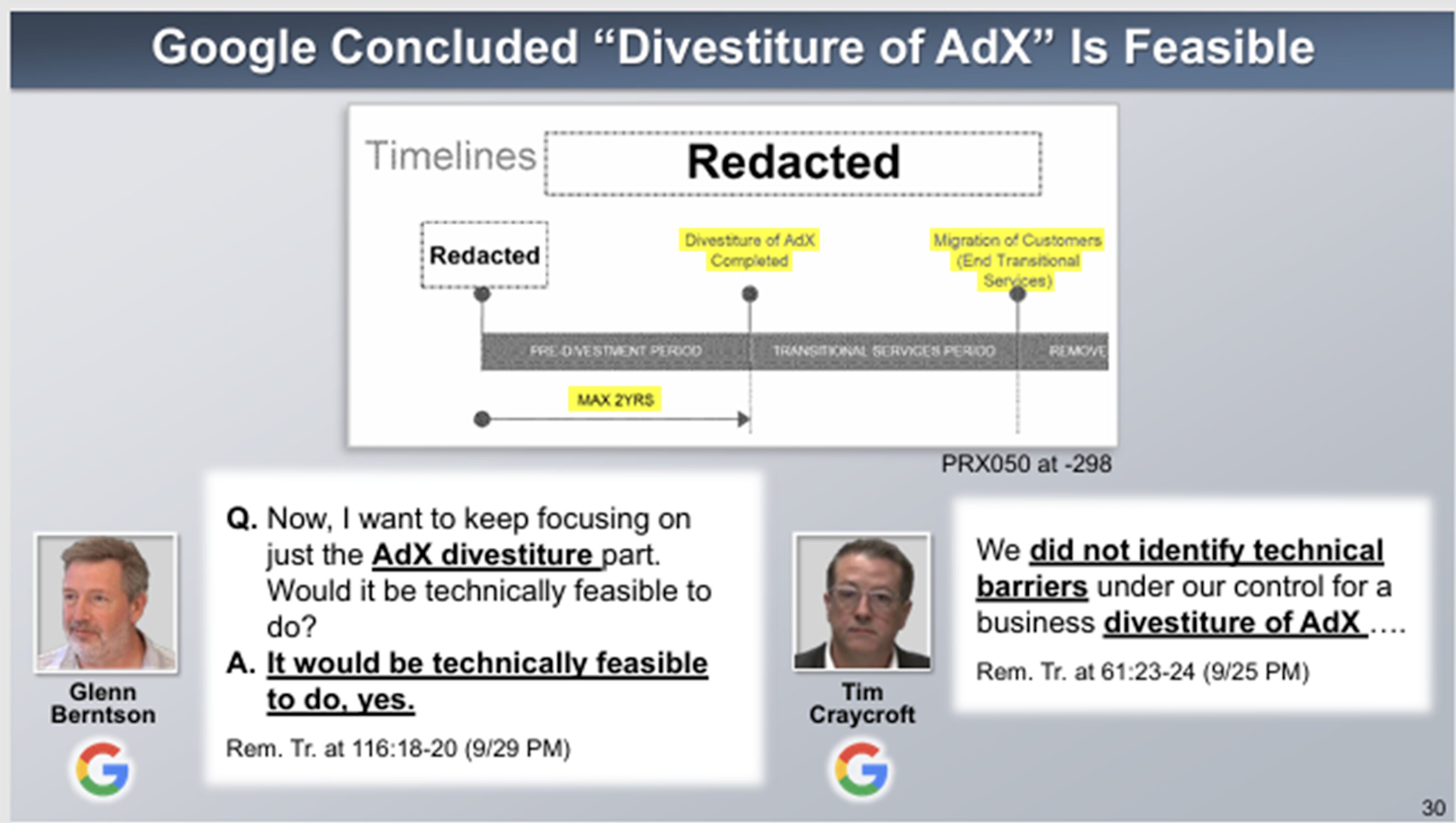
Google employees testified that divestiture was technically feasible
(slide from DOJ closing arguments).

Excerpt from Big Tech on Trial’s coverage.
Read Big Tech on Trial’s coverage of the Google adtech case here, including coverage of closing arguments from the remedies phase here.
Read Economic Liberties’ explainer on Google’s monopolization of online advertising here.
Learn more about Economic Liberties here.