Gemini’s Rapid Rise Proves Google Antitrust Remedies Must Be Strengthened, Economic Liberties Tells D.C. Circuit
Washington, D.C. — The American Economic Liberties Project filed an amicus brief this week calling on the U.S. Court of Appeals for the D.C. Circuit to strengthen the remedies imposed in the government’s landmark monopolization case against Google and direct the district court to ban Google from paying distributors like Apple and Samsung for default positions on their devices.
The brief argues that Judge Amit Mehta made a critical mistake by allowing Google to continue paying device makers for default placement, as Google is now using the same tactic that built its illegal search monopoly to dominate AI.
In January 2026, Google and Apple jointly announced that Apple would power Siri with Gemini for a price of $1 billion. But that deal pales in comparison to the estimated $20 billion Google pays Apple each year to preserve its search monopoly — underscoring that the companies’ broader financial relationship remains one in which Google apparently subsidizes Apple’s adoption of its search engine and now its AI. Additionally, Google has been paying Samsung “enormous sums” to make Gemini the default AI assistant on Galaxy phones. With these and similar tactics, Google is now using the profits, data, and infrastructure from its search monopoly to dominate the generative AI (GenAI) market.
Economic Liberties urges the D.C. Circuit to ban Google’s default payments for both its search and GenAI products, require divestiture of Chrome, and reject Google’s attempt to eliminate remedies related to data sharing and search syndication.
“Anyone who uses Google can see that search has gotten worse. Consumers are forced to sift through more ads and lower-quality results because Google no longer has to compete for their business. That’s what monopoly power does,” said Katherine Van Dyck, Senior Fellow at the American Economic Liberties Project and Principal at KVD Strategies. “If Google is allowed to use the same exclusionary payments that locked up search to consolidate its power over GenAI, we’ll end up with another market where consumers have fewer choices and worse products. The D.C. Circuit has an opportunity to restore competition before history repeats itself.”
“GenAI is at a crossroads. Google is already wielding unearned advantages from its illegal search monopoly to make Gemini the default GenAI experience for millions of users,” said Laurel Kilgour, Research Manager at Economic Liberties. “Meanwhile, Google’s search monopoly is undiminished, even though some bans on Google’s conduct have been in effect since February. The appeals court has a duty not to rubber-stamp remedies that fall an order of magnitude short of restoring competition.”
The evidence for Google’s steadily growing dominance is stark. Since December 2024, Gemini’s consumer chatbot market share has quadrupled from 7% to nearly 30%, and the Gemini app now has 950 million monthly active users, nearly matching ChatGPT’s 1 billion. Roughly 75% of searches using Google’s new AI Mode reportedly never send users anywhere else on the web, keeping both traffic and data inside Google’s ecosystem. In addition to Apple’s decision to use Gemini to power Siri, Meta and Anthropic — which Judge Mehta identified as potential disruptors of Google’s monopoly power in his remedies opinion — have retreated from consumer-facing competition. Instead, Anthropic focuses on enterprise markets while committing to spend $200 billion on Google Cloud services and chips, and Meta uses Gemini so much that Google started imposing usage caps. On its Q2 2026 earnings call, Google itself called Gemini “a key driver of growth.”
Google’s appeal brief argues that remedies should be limited to banning certain contractual terms (“prohibitory injunctions”). But those remedies have been in effect since February 2026, and Google’s share of the U.S. general search market shows no signs of shrinking–showing that the remedies Google wants are not enough by themselves.
As Economic Liberties’ brief states: “GenAI has not and will never fully discipline Google’s GSE monopoly. Google’s GSE monopoly disciplines GenAI.”
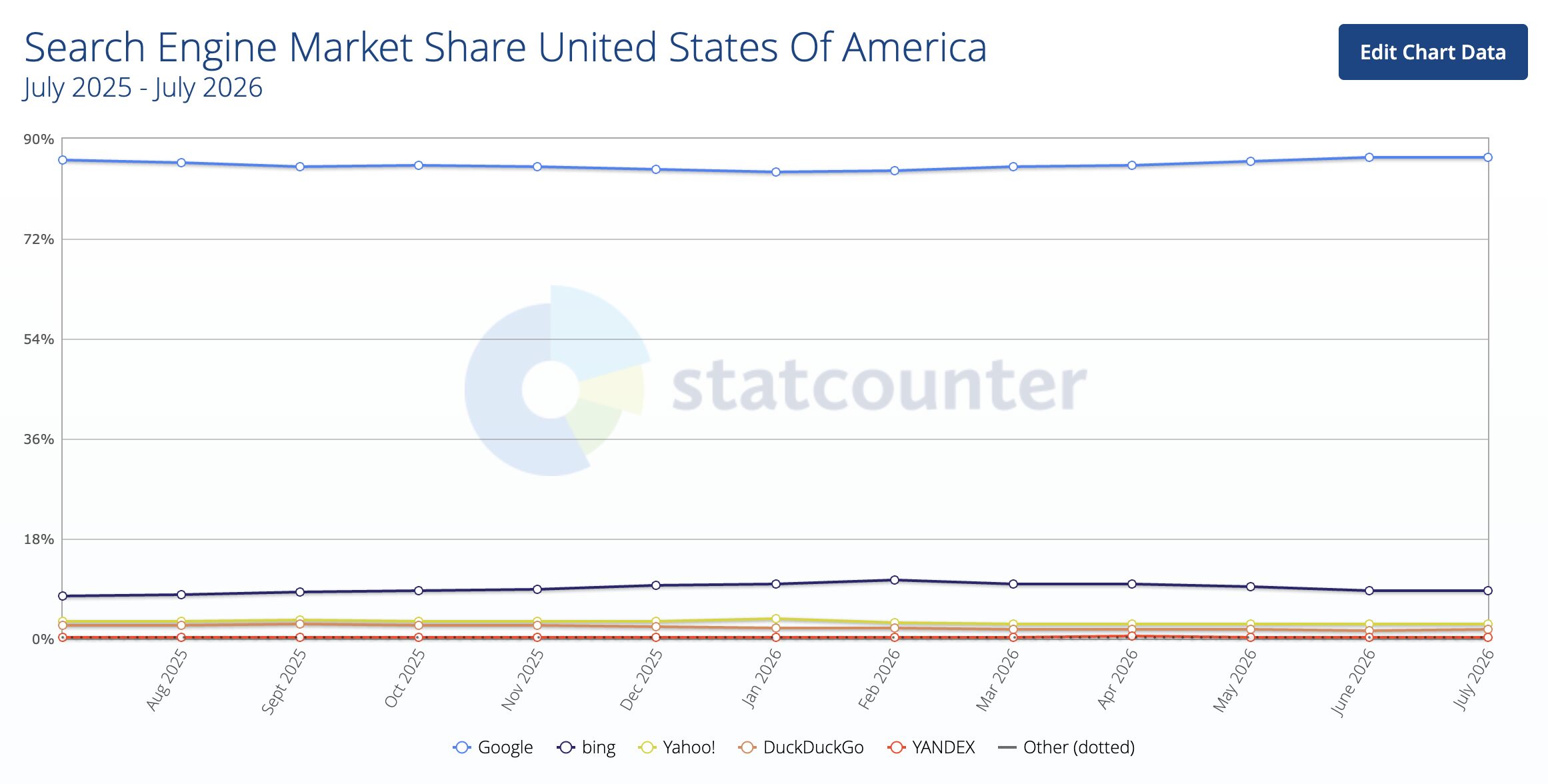
Google’s share of search-driven click-throughs to websites, at the top of the chart, still dwarfs all other competitors at the bottom of the chart.
Background:
In August 2024, Judge Mehta ruled that Google illegally maintained its search monopoly through exclusive “pay-to-play” agreements with search engine distributors, paying tens of billions of dollars every year to Apple, Samsung, AT&T, and Mozilla Firefox to secure default placement across browsers, homescreen widgets, and voice assistants.
The following September, Judge Mehta issued his remedies ruling. The order restricts Google’s ability to require exclusive distribution of its search and GenAI products, and mandates Google to share certain search data and syndicate its search index with qualified competitors on a limited basis. But the court rejected other major proposed remedies, such as a ban on default payments for placement, divestiture of Google’s Chrome browser, and contingent divestiture of the Android operating system. It also rejected proposed protections for publishers.
Both Google and the Department of Justice have appealed to the D.C. Circuit. Google is challenging both the monopoly finding and the remedies. The DOJ, joined by 38 state attorneys general, filed a cross-appeal pressing for stronger remedies including a ban on default payments and Chrome divestiture. The parties’ reply briefs will be due in late October. Oral arguments before a three-judge D.C. Circuit panel are expected in early 2027, with a final ruling potentially reaching the Supreme Court.
Read the full amicus brief here.
Read Economic Liberties’ prior amicus brief regarding legal standards for remedies here.
Track the influence of Google’s President of Public Affairs, Kent Walker, on AI policy here.
Learn more about Economic Liberties here.